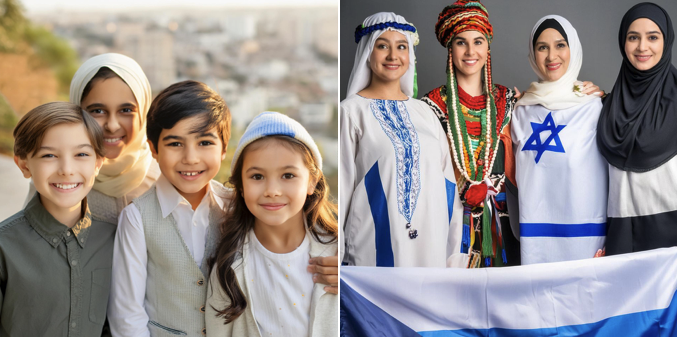
Is the value of a mother’s life in Israel greater than that of a mother in Palestine? Does a child in Russia inherently deserve more than a child in Ukraine? In our interconnected world, where conflicts brew and lives are lost daily, it’s imperative that we confront these profound questions that should impact our daily lives. These questions should challenge our moral compass, but why don’t they?
Where are our global religious leaders amidst these crises? Shouldn’t their teachings of love, respect, and forgiveness guide us away from the horrors of wars and conflicts? Regardless of our origins or beliefs, shouldn’t every human have the fundamental right to live in peace?
While borders are important, why do they become justifications for hate? Shouldn’t basic human rights transcend national boundaries? Why do the world’s most powerful “free” nations often turn a blind eye to violence elsewhere in the name of freedom? How long will we remain complicit in the suffering beyond our own borders? And as we fight for freedom, are we fighting for our own concept of freedom, or should we ask a child to define freedom for us? Are we truly becoming wiser as we grow older?
Let’s unequivocally stand against violence, separating good from evil without the taint of politics, religious biases, or financial agendas. It’s time to remind our leaders—political, religious, judicial—that safeguarding human lives must be their utmost priority. Religious figures, you were called to inspire love and compassion, not silence in the face of suffering. As Nelson Mandela once said, “There can be no keener revelation of a society’s soul than the way in which it treats its children.”
Traveling the world, I witness communities grappling with these existential questions daily. Why do our leaders obsess over trivial rules of dress and diet more than the plight of dying children and persecuted families? Have we lost sight of the true essence of compassion and the divine examples set before us?
I firmly believe that if religious leaders convened regularly across the globe, they could shift global perspectives and mobilize action against violence in all its forms. As ordinary people, we cannot ignore the daily cries for help, the haunting videos of destruction and despair that inundate our screens. Can we, as a generation, pause our relentless pursuit of material gain and technological advancement to prioritize nourishing and caring for one another?
Nothing should be more sacred than a mother’s love for her children. They deserve, at the very least, the tools and a peaceful environment to impart their wisdom without fear of daily atrocities. Let’s momentarily halt the construction of temples, mosques, synagogue and instead build bridges of empathy and understanding.
It’s critical that we, as humans, utilize our resources—regardless of their size—to help one another. Money is often a contentious topic, but I believe that if love isn’t part of your bank account, it’s unlikely that love has found a place in your heart.
Are you that leader? What are your priorities, and what does your faith compel you to do in the face of global violence? Can political strategies ever justify inaction against human suffering?It’s time to redirect resources towards human welfare, fostering unity rather than further division. Together, let’s embody the generation that places love over hate, compassion over apathy, and humanity above all else. What did your savior, prophet, or angel leave behind that led to the creation of the organization you follow today? I am not a religious expert, but I know that most churches were built based on the example of a figure (in my case, a Savior) who came to this planet to preach love, respect, and forgiveness. Is that the focus of your own faith today?
For each of us on this beautiful planet, I issue a challenge: for the next 90 days, instead of merely hearing your leaders, use your eyes to truly see what they are communicating. Through this, you may uncover profound lessons that can inspire them to embody their true purpose. Let’s collaborate towards a better world, where learning through observation leads to transformative change. Share your stories, your insights, and let’s listen to each other with open hearts to inspire genuine solutions.
I am not a leader; I am a simple human who sheds tears weekly over the senseless destruction of families and children worldwide. Violence deserves accountability through justice, not exploitation to sow discord among cultures. Can we be the generation that pauses our reliance on technology to focus on nourishing and loving one another globally? Let’s courageously remind our leaders—be they priests, judges, ministers, or chaplains—that most religions were founded on figures who taught love, respect, compassion, and forgiveness. It’s time to firmly denounce organized violence and reclaim our shared humanity.
Lastly, I will share one of my favorite quotes ever: “Not all of us can do great things. But we can do small things with great love.” — MOTHER TERESA
With all my faults, mistakes, and poor judgments from time to time, I can easily express to you that I love you and that I am grateful that we are humans chosen to be part of the same planet at the same time.
Please pray for and support the families in Palestine, Israel, Ukraine, and Russia who have been greatly impacted by the evil decisions of those in power.
Fabio DeMelo